AI ROI: 2026 Benchmarks
Download Report


There’s a specific point in most enterprise AI programs where the trajectory changes. The early phase is encouraging. Productivity climbs. Costs dip. Leadership sees enough results to fund expansion. And then the curve bends. Not downward, but flat. More users adopt. More use cases launch. More budget flows in. Yet the incremental return on each new dollar starts shrinking rather than compounding.
The benchmark data from 255 enterprise leaders puts a number on where this happens:
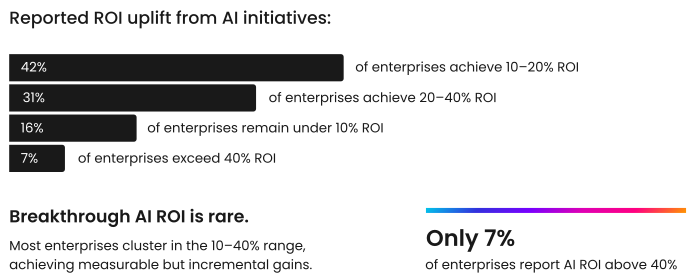
The majority aren’t failing. They’re generating real value. But they’ve hit a structural ceiling that more adoption, more tools, and more budget won’t lift on their own.
What drives the plateau isn't a decline in AI capability. It’s a gap between how organizations defined value when they started and what their programs need to measure now.
Three structural factors explain why enterprise AI ROI flattens after early wins, and each one points to a different lever for breaking through. Understanding these factors is often what clarifies the build or buy AI decision for teams evaluating their next move. So to make things easy for you, let’s dive right in.
The first issue is that organizations define AI value during the pilot phase. And that definition then becomes the ceiling against which all future performance is measured. The benchmark data reveals how sharply value priorities shift across maturity stages.
Pilot-stage organizations over-index on risk and quality improvement, with 66.7% citing it as a primary goal. And it makes sense. Early programs need to prove that AI can be trusted, that it reduces errors, and that it doesn’t introduce new risks. The KPIs in this phase are time saved, error reduction, and risk mitigation.
But as programs scale, the priorities change. Scaled organizations tilt toward revenue growth, with 69.9% identifying it as their primary goal. Innovation jumps to 54.8%. And by the time programs are fully industrialized, the priorities have shifted again. Customer experience leads at 64.4% and productivity uplift at 65.2%, reflecting a focus on structural leverage rather than operational safety.
The problem is that most organizations carry their pilot-era value definitions into their scaled programs. An AI initiative that was measured by time saved in its first six months is still measured by time saved two years later, even though leadership expectations have moved to revenue impact, cost structure leverage, and experience transformation.
The result is a maturity trap. The program is delivering more, but the measurement framework is anchored to a definition of value that the organization has already outgrown. ROI plateaus because the organization has not moved to the next value definition. The fix is deliberate and sequential. At each maturity transition, revisit what value means.
The second issue is the result of most enterprise AI deployments operating in assistance mode. Copilots help draft documents. Summarization tools condense reports. Recommendation engines surface options for human review. These applications produce real productivity gains, but have a structural ceiling on the value it can create.
The research draws a clear line. AI that accelerates tasks improves convenience. AI that automates workflows creates leverage. The distinction isn't semantic, it’s economic. When AI helps a human work faster, the value is bounded by the human’s capacity and the process they operate within. When AI executes workflow steps end to end, removing handoffs, rework loops, and manual intervention, it changes the cost structure of how work gets done.
The data shows a specific inflection point. AI value rises materially once workflow automation exceeds approximately 40%. Below that threshold, organizations are primarily in assistance mode. Essentially just getting things done faster but not fundamentally changing their operating economics.
The top 7% of enterprises in the benchmark average approximately 63% workflow automation. Their production AI doesn’t just help people make decisions. It executes the decision path, with human governance on exceptions rather than every transaction.
The third plateau driver is the most subtle and the most common. Organizations successfully scale AI usage, expanding access, increasing weekly adoption, and improving perceived model performance. But they continue to measure success using the same metrics they established in year one. Time saved and error reduction are valid early metrics. They're insufficient for measuring the impact of a scaled program.
The mismatch creates a specific problem. Leadership expectations shift toward revenue impact, cost structure leverage, and experience transformation. But the reporting framework still centers on hours saved per employee and error rates reduced. The executive team sees stagnation. The AI team sees continued improvement. Neither is wrong. They're just looking at different definitions of success through the same dashboard.
The benchmark reveals which metrics actually drive executive confidence. Quality improvement is the strongest predictor of satisfaction with AI initiatives, with a correlation of 0.53. That is stronger than error reduction (0.32), throughput increase (0.31), workflow automation (0.28), and even adoption levels (0.26).
Yet quality is often under-instrumented. The average quality improvement score across the benchmark is 7.6 out of 10, and only 56.9% of enterprises rate their quality improvement at 8 or above. Which reveals there’s significant room to improve, and significant room to measure.
Payback speed shows little relationship to satisfaction. Executives value trust, consistency, and reliability more than rapid wins. This is a critical finding for teams that emphasize time-to-value in their reporting. Contrary to their belief, the speed at which AI pays back is less important to leadership than whether AI produces reliable, repeatable outcomes that reduce operational risk. Shifting to outcome-based AI pricing models can help realign incentives around the metrics that actually matter at scale.
The organizational context reinforces the pattern. Even as AI adoption reaches structural scale, most enterprises have not formalized AI as a mandatory part of how work gets done. Only 25.9% expect AI use in most workflows. Another 28.2% expect it in some. And 29.4% merely recommend it. When AI remains recommended rather than required, the organizational pressure to evolve metrics simply doesn’t materialize.
The ROI plateau is a signal, not a dead end. It indicates that the organization has outgrown its current execution model. The benchmark identifies two specific points where enterprises stall:
Breaking through requires action on all three fronts simultaneously:
The benchmark data shows that these aren't incremental improvements. The top 7% aren't doing slightly more of what everyone else does. They operate with a fundamentally different execution model:
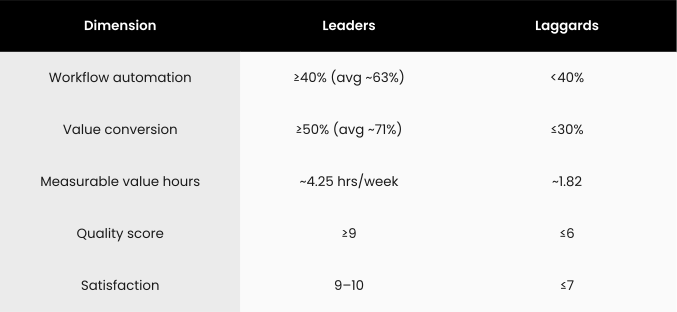
These are traits of the benchmark’s top 7% share, and they're replicable by any enterprise willing to rethink its approach to value capture. The plateau is where most enterprise AI programs live. It doesn’t have to be where they stay.
To review the specific thresholds where AI ROI compounds vs plateaus, download the full report about Enterprise AI ROI Benchmarks 2026.